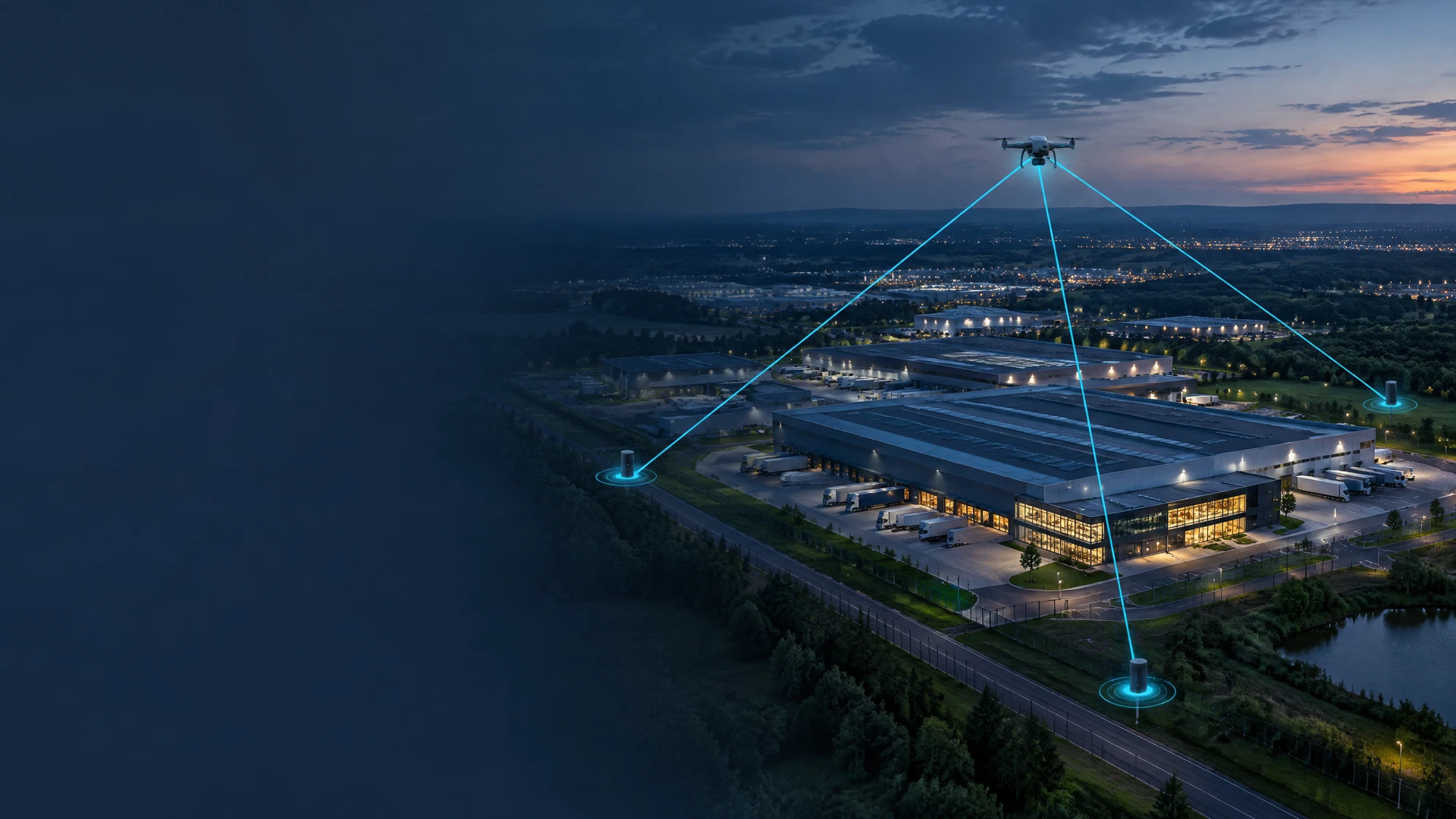
UAV acoustic localization converts distributed sound capture into actionable direction and location intelligence for low-altitude security operations.
Illustrative deployment scenario
Location context across a distributed site
Coordinated acoustic nodes can help turn sound events into directional cues across a large logistics or industrial campus. Those cues help teams prioritize visual confirmation where it matters most.
NEW ARK
From sound signatures to operational awareness
New Ark applies synchronized microphone-array sensing, direction estimation, and AI acoustic classification to help operators understand where an audible UAV threat may be approaching from. When connected with optical or thermal tracking, acoustic localization can guide visual confirmation and reduce search time.
Acoustic localization is most effective when it is part of a layered operating concept. New Ark supports integration discussions for operator workstations, optical tracking modules, and site-specific sensor layouts.
Frequently asked questions
UAV acoustic localization FAQ
What does acoustic localization provide?
It provides estimated direction and location context for relevant acoustic events, supporting a faster operator search and verification workflow.
Why use more than one sensing node?
Distributed nodes provide broader site coverage and allow multiple direction cues to be assessed together.
Can localization be adapted to an existing security center?
Yes. Integration options can be discussed around existing visual systems, operator workstations, and site workflows.